OUR INITIATIVES
The textile industry, our industry, is one of the worst performers when it comes to sustainability – a position we don’t intend to end up in. We believe it’s our responsibility as a clothing manufacturer to create a sustainable value chain. Doing so requires both daily work and bigger leaps from time to time. Let us tell you about our various initiatives.
SUSTAINABILITY LABELLING
MADE IN GREEN - TOUGH STANDARDS, EASY CHOICE.
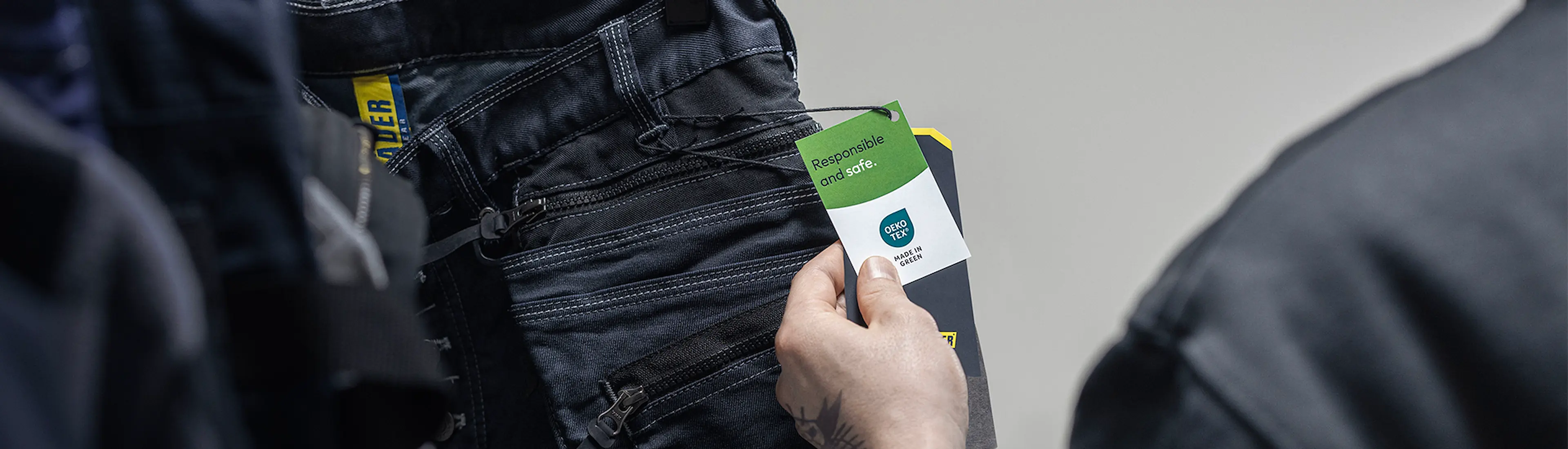
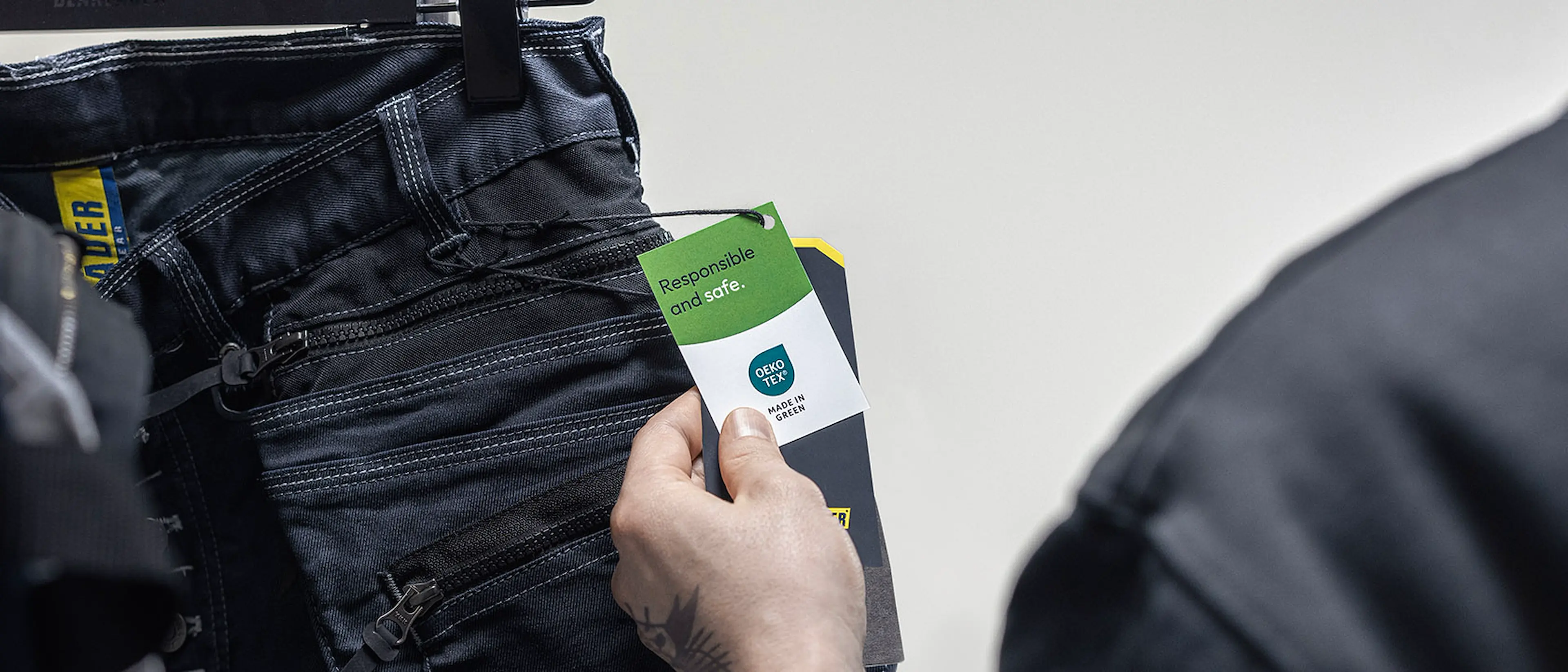
Sustainability labels can mislead customers – or revolutionise sustainability efforts. We’ve chosen to work with OEKO-TEX® MADE IN GREEN because we wanted the label with the highest standards for social and environmental sustainability. We’re forging ahead with ensuring that garment after garment meets the criteria and won’t relax until all Blåkläder products have the Made in Green label. Feel free to ask us how it’s going.
Compared to other consumer goods, in 2020 clothing and textiles consumed the third highest amount of water and land, used the fifth highest amount of raw materials and caused the fifth highest greenhouse gas emissions, according to the European Environment Agency. By no means rankings to be proud of.
So in 2018 we started the process of verifying our workwear for the independent and internationally recognised OEKO-TEX® MADE IN GREEN sustainability label – one of the toughest certification processes that clothing manufacturing can go through. They took over half a decade to verify everything, but in 2024 we were able to award several of our most popular garments Made in Green labels, including our best-selling 1459 service trousers.
Our target is to have 75 percent of our range validated for climate impact, social conditions and harmful substances. It has been a gruelling job, but we’ve actually achieved it without having to make any changes to production – which clearly indicates that we’ve been doing things right from the start. But we won’t be satisfied until everything we sell meets the Made in Green requirements.
More about OEKO-TEX® MADE IN GREEN
Oeko-Tex offers standardised solutions for greater transparency and sustainable optimisation of manufacturing processes in the textile and leather industries. The organisation’s certifications and labels help consumers choose safe products from a sustainable and transparent value chain.
The Made in Green label indicates that the product is manufactured in a value chain certified under STeP by Oeko-Tex, a standard that audits the entire operation for environmental and social sustainability. STeP certification means that production of the garment shows consideration for the climate, ensures high quality and takes place in facilities with safe and fair working conditions. Products with the Made in Green label must also be able to demonstrate full traceability and be tested for harmful substances.
OUR PROMISE
LIFETIME GUARANTEE ON SEAMS
We’re happy that our seams stand up to scrutiny. After all, hard-wearing workwear and fragile seams don’t go together. Our lifetime guarantee on the seams of our garments is one of the many ways we combat wasteful consumption.
We want our clothes to be put to work, and that means there’s no time for avoidable problems like split seams.
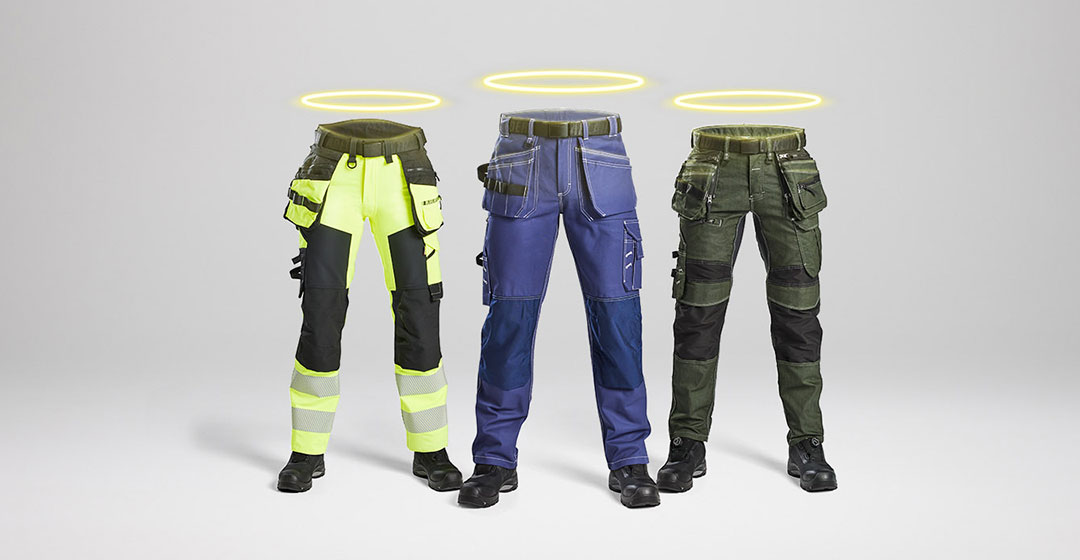
Our work trousers are made from extremely durable materials, with triple stitching and reinforcement in the most susceptible areas. We can’t imagine it will, but if a seam does split in an otherwise serviceable garment, we are happy to repair or replace that garment. Provided, of course, that the seams haven’t been worn by sharp edges and tools. They’re not made of titanium (that would be uncomfortable).
Contact the retailer where you bought your trousers for help under the guarantee.
Look after your clothes and they’ll last longer
Our materials, reinforcements and seams can take a beating, but when you work hard, your clothes work hard. Give them a little love when they need it, just like we did in production. Washing at the right temperature and mending small holes before they grow can help your workwear last even longer.
ENVIRONMENT
HOW WE REDUCE EMISSIONS FROM DYEING
Textile dyeing is one of the most resource-intensive stages of garment production and accounts for a significant share of all industrial water pollution. That is why Blåkläder has chosen to work differently.
Dope dyed fibre = 85% less water & 90% less chemicals
Dope-dyed fibres – for synthetic materials
For polyester and other synthetic fibres, we have chosen to work extensively with dope-dyed fibres. Instead of dyeing the fabric afterwards, colour pigments are added at the point when the fibre itself is produced.
The result is up to 85% lower water use and 90% less chemical use compared with conventional dyeing. At Blåkläder, we work with every material and component that goes into our garments, so when we convert a lining to a dope-dyed version, the savings per individual garment style may seem modest. However, because the same lining is used across hundreds of styles in our range, this conversion saves us hundreds of tonnes of CO2 each year.
Dope dyeing also delivers colours that retain their performance better over time, both through repeated washing and exposure to UV radiation from the sun. Today, dope-dyed fibres are used in the majority of our garment range, and expanding that use is a clear environmental objective for us.
Spray dyeing – for natural materials
Natural materials such as cotton and linen require a different approach. That is why Blåkläder has chosen to invest in the Swedish company Imogo and its resource-efficient spray dyeing technology.
With Imogo’s technology, the colour is sprayed directly onto the fabric and fixed at room temperature. Compared with traditional piece dyeing, this reduces the use of water, energy and chemicals by more than 90%. Thanks to recirculation, wastewater can also be reduced by up to 99%.
Our investment is not about keeping the technology to ourselves. On the contrary, we hope more material suppliers will have the opportunity to use it. The aim is to make it easier for the entire industry to choose a more sustainable alternative to conventional textile dyeing.
Combining dope-dyed fibres with spray dyeing offers enormous potential for reducing climate impact in one of the most resource-intensive parts of production. It is one of several steps we are taking to reduce our environmental impact, garment by garment.
QUALITY CONTROL
OUR LABORATORY - TESTING TO PERFECTION
We don’t want anyone throwing away their shoes just because they don’t fit well or don’t do the job, which is why we meticulously test every safety shoe we make. This is partly about keeping our customers happy. But also about not creating unnecessary climate emissions. The fewer shoes that are made, the better it is for the planet. And the best thing we can do is to minimise the reasons for buying new products.
Our test lab keeps us one step ahead in the development of safety shoes.
– Lars Johansson, Product Manager Shoes, Blåkläder
Opened in 2022, the Blåkläder shoe factory is located in the village of Ulapane, outside Kandy in Sri Lanka. The factory employs 600 people and has the capacity to produce 900,000 pairs of safety shoes annually.
It’s also home to our high-tech test lab, which checks the quality, functionality, ergonomics and safety of our work shoes. Not a single model of shoe is sent out into the world from Sri Lanka without passing through the lab.
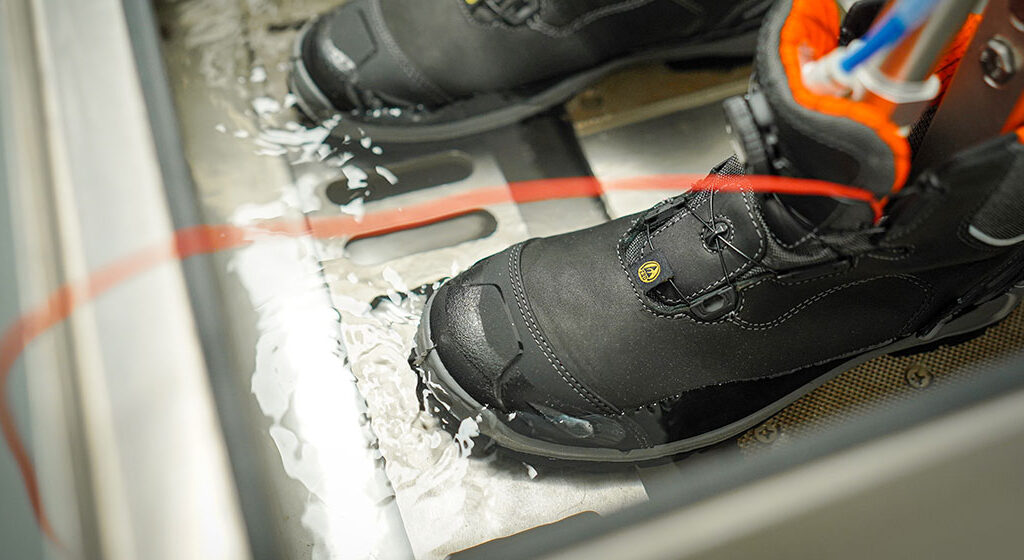
The 102-square-metre lab is where innovation, technical advances, developments and extremely thorough testing take place. Everything is tested here to ensure that the shoes deliver what they promise – the quality that Blåkläder’s customers expect. And after successful tests, we test again. And again.
Our test lab delivers many benefits in our continued quest to create the perfect safety shoes. It’s unusual to have such a large and modern laboratory, but we saw no other option than to go all out. Now we can stay one step ahead in the development and quality of our safety shoes.